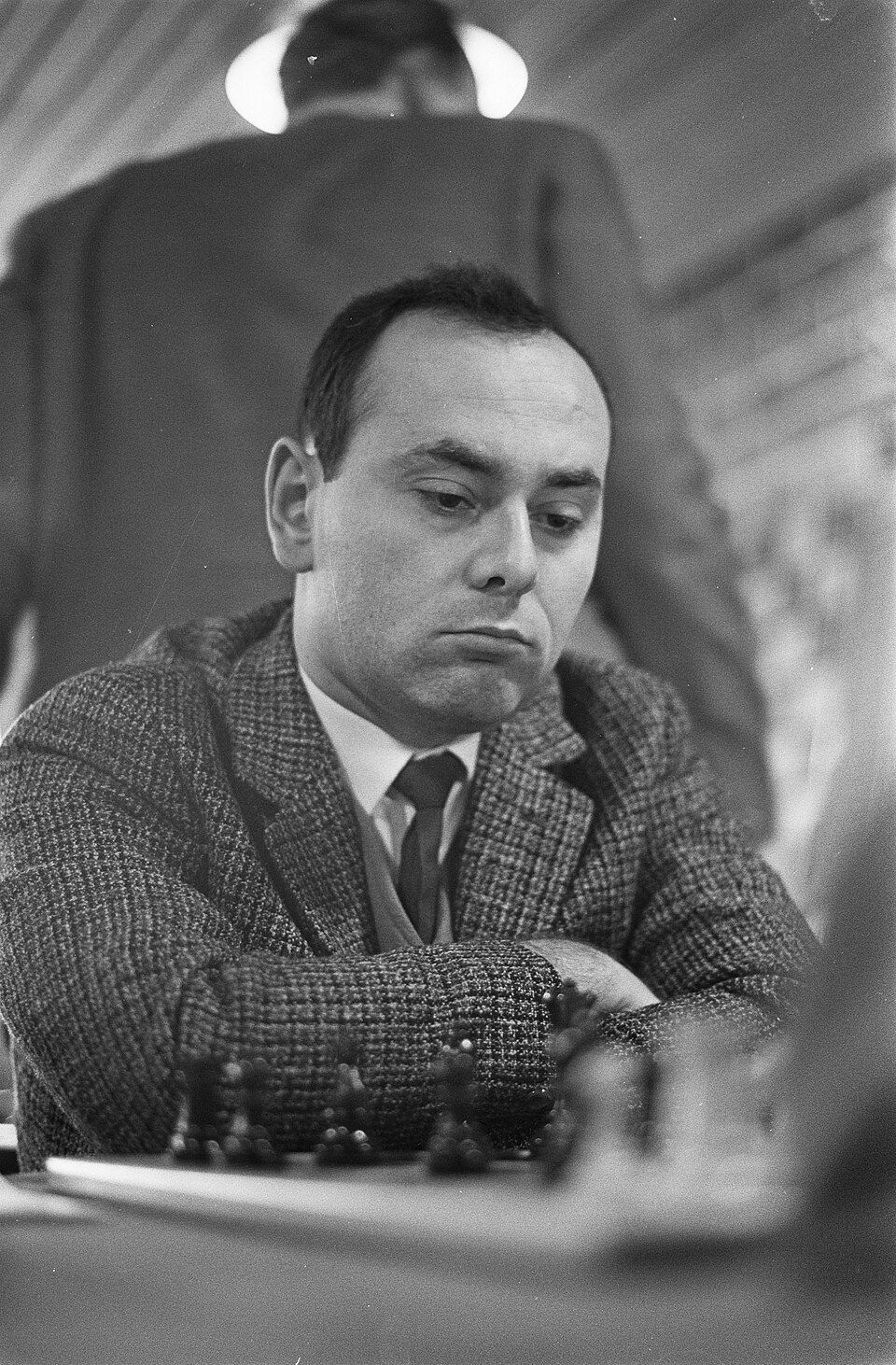
Lajos Portisch Chess Biography: Hungary’s Enduring World Championship Candidate

Lajos Portisch was one of the strongest chess players never to contest a world championship match. The Hungarian grandmaster remained near the summit of elite chess for decades, reached the Candidates stage eight times, won nine Hungarian championships, and helped Hungary break Soviet domination at the 1978 Chess Olympiad. His career was built less on spectacle than on preparation, positional judgment, opening research and exceptional consistency.
Lajos Portisch at a glance
Born on 4 April 1937 in Zalaegerszeg, Hungary, Portisch started chess at twelve—late by elite standards. He became a Hungarian master in 1955, received the International Master title in 1958 and became a Grandmaster in 1961. By the 1960s he was established among the world’s leading non-Soviet players, and he remained a serious world-championship contender into the late 1980s.
Historical rating summaries place him as high as world No. 2 in January 1981. FIDE’s own retrospective describes him as a top-ten player for roughly a quarter of a century. That longevity is central to the Lajos Portisch chess biography: he did not produce one short peak, but returned to the championship cycle again and again across several generations.
A late start in Zalaegerszeg
Portisch’s route to the top did not resemble the modern prodigy system. In a later interview, he recalled beginning at twelve in a small Hungarian town with few chess books and hardly any access to clocks. The club owned only a handful of clocks and protected them for team matches, so the young Portisch could not build his game through constant blitz. He described his early development as slow and considered his initial play much more positional than tactical.
The turning point came in 1955. Portisch finished fourth at the World Junior Championship in Antwerp, an event won by Boris Spassky. The result increased his confidence and helped him enter the final of the Hungarian championship. At eighteen he decided to become a professional chess player after briefly beginning economics studies. Within six years he had earned the grandmaster title.
Nine Hungarian championships and an international breakthrough
Portisch won or shared the Hungarian championship nine times between the late 1950s and 1981. In a country with a deep chess culture, that record established him as Hungary’s leading player before the rise of later stars such as Judit Polgár and Peter Leko.
His international results were defined by breadth and repetition. He won or shared first place in major round-robin tournaments across Europe and the Americas, faced virtually every world champion of his era, and continued to qualify for the strongest events in his forties and fifties. FIDE noted that he was capable of defeating three world champions in a single tournament—a measure of how dangerous his apparently controlled style could become.
Eight World Championship Candidates appearances
Portisch reached the Candidates stage eight times, competing in both match and tournament formats. His first appearance came in the 1960s, and his final qualification came in 1987 for the 1988–89 cycle. The repeated qualifications are more significant than any one match: for more than twenty years he kept surviving Interzonals and qualification events against changing fields of elite opposition.
His closest approaches came in 1977 and 1980. In the 1977 Candidates quarterfinal at Rotterdam, Portisch defeated the brilliant Danish challenger Bent Larsen 6½–3½. He then met former world champion Boris Spassky in Geneva. Portisch won two games, including a 67-move victory with Black, but Spassky ultimately prevailed 8½–6½ after fifteen games.
Three years later, Portisch faced Spassky again in a Candidates quarterfinal in Mexico. The match ended 7–7, and Portisch advanced on the competition’s tie-break rule because of his greater number of wins with Black. He reached the semifinal for a second time. Although he never earned the final match for the crown, two Candidates semifinals and eight total appearances place him among the era’s most persistent challengers.
Playing style: positional, scientific and prepared
Portisch described his own chess simply as positional. Observers often called him the “Hungarian Botvinnik” because of his disciplined preparation, strategic play and analytical approach. Portisch himself rejected the idea that he was merely an imitation of Mikhail Botvinnik, but the comparison captured something real: both treated opening research and tournament preparation as systematic work.
His positions were frequently built around sound pawn structures, long-term piece coordination and carefully timed breaks. He was comfortable in Queen’s Gambit structures, the Queen’s Indian and English Opening, while his Black repertoire included durable Sicilian and Queen’s Gambit Declined systems. The objective was not to avoid complications. Rather, Portisch tried to reach complications that he had understood earlier and more deeply than his opponent.
FIDE’s retrospective portrayed him as a scholar of chess who developed entire opening concepts in private analysis. His best games show that strategic control could lead to direct attacks: once an opponent’s pieces were restricted or a weakness fixed, Portisch was capable of calculating sharply and converting without sentiment.
The 1978 Olympiad: Hungary breaks through
Portisch’s national-team career was extraordinary. OlimpBase records twenty Chess Olympiad appearances between 1956 and 2000. Across 260 games he scored 176½ points: 121 wins, 111 draws and only 28 losses, a score of 67.9 percent. He collected six team medals and five individual board medals.
The defining team achievement came in Buenos Aires in 1978. Playing on first board, Portisch led Hungary to the gold medal ahead of the Soviet Union. Hungary’s victory interrupted the USSR’s long run of Olympiad titles and remains one of the landmark team results in chess history. Portisch also helped Hungary share the highest match-point total in 1980, when the Soviet team took gold on tie-break.
His Olympiad record shows a different form of greatness from an individual title run. National teams relied on him for forty-four years, against opponents ranging from the postwar generation to players shaped by computer preparation.
Portisch against the champions
Portisch’s career overlapped with Botvinnik, Smyslov, Tal, Petrosian, Spassky, Fischer, Karpov and Kasparov. He competed successfully enough against that group to remain in the championship conversation across several eras. His rivalries with Larsen, Spassky and Viktor Korchnoi were particularly important because those players, like Portisch, spent years trying to break through the Soviet-centered qualification system.
The 1977 victory over Larsen demonstrated his match discipline. The two encounters with Spassky showed both the narrowness of the margins at Candidates level and Portisch’s ability to return after disappointment. Even in 1993, at fifty-six, he came close to qualifying again in a field containing Boris Gelfand, Vasyl Ivanchuk, Viswanathan Anand, Gata Kamsky and Vladimir Kramnik.
Music, later life and recognition
Chess was not Portisch’s only serious pursuit. He became known as a trained and passionate singer with a particular love for Schubert. After reducing his tournament schedule in his sixties, music occupied an increasingly important place in his life. During the 2024 Budapest Olympiad, the eighty-seven-year-old grandmaster performed an aria evening at the Petőfi Museum of Literature.
Hungary named him a Sportsman of the Nation, one of the country’s highest sporting distinctions. He was inducted into the World Chess Hall of Fame in 2023 alongside Judit Polgár. Those honors recognize more than results: Portisch served as the central figure of Hungarian chess during an era when competing with the Soviet system required exceptional institutional and personal resilience.
Lajos Portisch’s legacy
Portisch’s legacy is the value of sustained excellence. He was not world champion, yet his record explains why chess history cannot be told only through title holders. Eight Candidates appearances, two semifinals, nine national championships, twenty Olympiads and decades in the world elite form a career that very few champions could match for duration.
For modern players, his games reward attention to preparation, structure and patience. Portisch showed that positional chess is not passive chess. His method was to understand a position deeply enough that tactical opportunities emerged on his terms. That combination of research and practical control made him Hungary’s enduring world-championship candidate.
Frequently asked questions
Was Lajos Portisch a world champion?
No. Portisch never played a world championship match, but he qualified for the Candidates stage eight times and reached the semifinals in both the 1977 and 1980 cycles.
What was Lajos Portisch’s playing style?
Portisch called himself a positional player. He was known for deep opening preparation, sound structures, strategic planning and precise conversion. The nickname “Hungarian Botvinnik” referred to his scientific approach, though Portisch did not consider himself a copy of Botvinnik.
What was Portisch’s greatest team achievement?
His defining team result was Hungary’s gold medal at the 1978 Chess Olympiad in Buenos Aires. Portisch played first board as Hungary finished ahead of the Soviet Union.
Related MyChessJourney biographies
Sources and further reading
Cover photograph: Ron Kroon / Anefo, Dutch National Archives, 12 January 1968. Wikimedia Commons — CC0 public-domain dedication.


Comments